Poverty
Little WomenPoverty is a persistent condition in the March family’s life, but Little Women does not treat it as a single, unchanging misery. It appears in complaints about missing presents and pretty things, in the sisters’ paid labor and household economies, in the father’s financial failure and absence, and in the temptations created by wealthier families. At the same time, the family’s poverty tests whether love, dignity, and usefulness can be valued above money, and the sisters’ responses gradually turn deprivation into a discipline of work, mutual care, and chosen independence.
Definition and Early Experience
Poverty first enters the story through the emotional vocabulary of the four March sisters. Jo grumbles that Christmas will not be Christmas without presents, while Meg looks down at her old dress and sighs that it is dreadful to be poor. Amy objects that some girls possess plenty of pretty things while others have nothing. These complaints are not identical: Meg feels the humiliation of worn clothing, Amy measures inequality through possessions and social comparison, and Jo resents the loss of the festive abundance she associates with childhood. Beth’s answer redirects the household’s attention toward what remains available to them: their parents and one another.
The family’s poverty is intensified by separation and uncertainty. Mr. March is far away because of the fighting, and the sisters fear that he may not return for a long time. Their home therefore bears both economic and emotional strain: scarcity is experienced alongside wartime absence, anxiety, and the possibility of permanent loss. The family does not deny hardship, but its habitual response is to preserve togetherness rather than allow money to define its worth.
Work, Income, and Family Solidarity
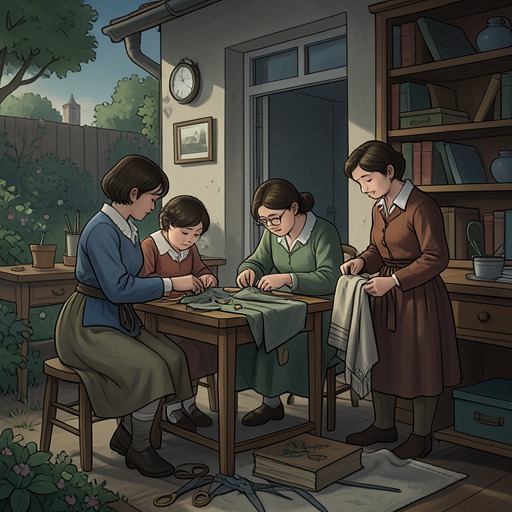
The immediate economic cause of the Marches’ reduced circumstances is Mr. March’s loss of property while trying to help an unfortunate friend. In response, Margaret and Josephine March ask permission to contribute to their own support. Their parents agree because they believe energy, industry, and independence cannot be cultivated too early. Paid work is consequently presented not as a disgrace but as practical moral training, although the sisters’ occupations also reveal how limited respectable opportunities for young women can be.
Margaret becomes a nursery governess and takes genuine pride in her small salary, yet poverty is especially painful for her because she remembers an earlier life in which the family home was beautiful and ordinary wants were easily satisfied. At the Kings’ household she repeatedly sees the life she lacks: ball dresses, bouquets, theater and concert talk, sleighing parties, and money spent on trifles that would have been precious to her. She usually suppresses her complaints, but the contrast makes her bitter and envious. Her difficulty is not simply hunger or homelessness; it is the loss of status, leisure, adornment, and remembered comfort.
Josephine March works as a companion to Aunt March, an irascible elderly relative who once offered to adopt one of the girls after the family’s troubles began. The Marches refuse because they will not surrender a daughter for the sake of a wealthy woman’s fortune. Friends warn that this decision may cost them a place in Aunt March’s will, but the family chooses continued unity over inheritance. Josephine accepts the companion’s position only because no better opportunity appears, and the arrangement becomes an uneasy but durable exchange: Aunt March receives an active attendant, while Josephine gains work and learns to manage a difficult household relationship without abandoning her independence.
Poverty and Female Independence
The novel repeatedly distinguishes economic dependence from social respectability. When Margaret is asked about her education during the outing with Laurie’s friends, she explains that she is a governess. Miss Kate’s response implies that such work is dreadful, and Margaret blushes and regrets her frankness. Mr. Brooke immediately defends her, insisting that young women in America value independence and are admired and respected for supporting themselves. The episode exposes the class stigma attached to women’s labor even when that labor is honest and necessary.
Mrs. March’s counsel to Margaret gives the family’s economic ethic its clearest statement. She hopes her daughters will be beautiful, accomplished, good, loved, respected, happily married, and useful, but she rejects the ambition of marrying rich men merely for money or living in splendid houses without love. Money is acknowledged as necessary and potentially noble when well used, yet it is not allowed to become the first or only prize. She would rather see her daughters as poor men’s wives who are happy, beloved, and at peace than as queens without self-respect. Poverty is therefore not romanticized, but neither is wealth accepted as a sufficient guarantee of happiness.
Josephine turns this principle into an artistic and financial ambition. When her stories are accepted for publication, she learns that the newspaper will print the two pieces without paying a beginner, while promising payment after improvement. She accepts the arrangement because it provides practice and a path toward future earnings. Her joy comes not only from seeing “The Rival Painters” in print but from imagining that writing may eventually support her and help the family. Publication transforms authorship from a private dream into possible economic independence, linking creative recognition with material responsibility.
That same responsibility produces one of the novel’s most striking acts of sacrifice. When the family needs twenty-five dollars to make Mr. March comfortable and bring him home, Josephine presents the money as her contribution. She insists that it was earned honestly and that she sold only what belonged to her. The family’s outcry reveals the price: she has cut off her abundant hair. The scene makes poverty visible in a bodily form, while also showing Josephine’s refusal to treat dependence as inevitable. Her hair becomes available capital, and the loss is painful precisely because it is both personal and useful.
Consumption, Marriage, and the Household Economy
Marriage does not erase poverty; it reorganizes its pressures. After Margaret marries John Brooke, the couple lives in the small house called Dovecote. Its garden, lawn, rooms, and furnishings are modest, but the home is made attractive through practical taste, books, pictures, flowers, and gifts carrying affectionate messages. Its material limitations are concrete: the hall could barely accommodate a piano, the dining room was cramped, and the kitchen stairs were hazardous. Yet the household’s value is not measured by marble tables, long mirrors, or lace curtains.
The household economy also depends on knowledge and unpaid domestic labor. Mrs. March explains that learning to cook and manage a home had once been playful, but became essential when the family could no longer afford hired help. Margaret begins married life with the expectation that such lessons will serve her even if John’s income later increases. A mistress of a house, however splendid, must understand how work is done if she wishes to be served well and honestly. Poverty thus gives domestic competence an economic force: cooking, accounting, sewing, and household management are forms of labor that protect a family when cash is scarce.
Aunt March’s response to Margaret’s marriage further illustrates how inheritance and gift-giving can regulate women’s resources. After declaring that Margaret would receive none of her money if she married John, Aunt March devises a way to honor the vow while still assisting the new household. Mrs. Carrol is instructed to purchase and mark a generous supply of household and table linen as her own present. Aunt March also gives the old-fashioned pearls promised to the first bride. The family enjoys the secrecy and absurdity of the arrangement, but the episode shows that material security may arrive through indirect gifts, family negotiations, and domestic goods rather than through straightforward inheritance.
Later, Margaret’s poverty becomes entangled with the social visibility of consumption. Sallie Moffat renews her friendship and invites Margaret into the wealthier household, where attractive possessions awaken old longings. Lonely while John is away at work, Margaret begins gossiping and shopping with Sallie. She knows John’s income and has previously kept exact accounts, but she dislikes being pitied and wants to avoid appearing poor. Small purchases, often unnecessary, accumulate because each seems too insignificant to justify concern. The episode shows poverty operating not only through deprivation but through the shame of being seen as deprived, a shame that can draw a careful household into debt or waste.
From Scarcity to Reproductive and Communal Work
The March sisters’ economic responses broaden as they mature. Josephine later asks to go to New York to teach Mrs. Kirke’s children and sew. She rejects the idea that the position is degrading: it is honest work, and she is not ashamed of it. Her proposed move combines restlessness with a practical desire to learn, earn, and escape excessive brooding over her own limited circumstances. Mobility becomes another form of independence, allowing work to carry her beyond the familiar home without severing her family ties.
Poverty also appears through unequal access to education and social confidence. During Laurie’s gathering, Amy is admired among the college young men and becomes a belle because she knows how to use her gift for fascination, while Josephine feels more at ease imitating masculine attitudes and accomplishments than observing the decorums prescribed for young ladies. The contrast does not reduce every difference to income, but it places the sisters’ social possibilities beside those of wealthier youths, whose money, schooling, leisure, and connections make public development seem natural.
The final economic horizon is not private accumulation but a productive community. Josephine announces that the profitable crop she and Fritz plan to raise will consist of boys: a good, happy, homelike school for little lads, with Josephine caring for them and Fritz teaching them. The plan converts the language of profit into a scheme of education, care, and shared work. What begins as a family struggling to survive scarcity ends, in the supplied arc, with poverty answered through an institution designed to give children a secure and affectionate home.
Moral and Narrative Significance
Poverty is the pressure that makes the March family’s values observable. The family refuses to exchange a daughter for a fortune, and Mrs. March refuses to define a successful woman by wealth or a splendid house. The sisters work for wages, publish writing, sacrifice possessions, keep accounts, learn domestic skills, and negotiate the humiliations attached to employment. Their poverty remains real, but it is repeatedly met through collective action rather than isolated self-making.
The crisis surrounding Elizabeth March’s scarlet fever deepens this economic perspective. While the household waits in fear, Margaret realizes that love, protection, peace, and health are richer blessings than luxuries money can buy. Josephine, caring for Elizabeth day and night, learns to recognize the depth and sweetness of her sister’s unselfish nature. The insight does not abolish material hardship; it changes the scale by which hardship is judged. Poverty has taught the sisters to count money, but illness teaches them to distinguish financial value from the forms of wealth that sustain life.
At its most complex, the novel neither claims that poverty is harmless nor suggests that affection alone pays bills. Food, clothing, wages, inheritance, education, and work remain consequential, and the sisters feel their absence sharply. Yet the narrative repeatedly asks what kind of life economic scarcity can produce when a family answers it with labor, mutual loyalty, and self-respect. Poverty is therefore both an imposed social condition and a recurring test of priorities: it exposes injustice, creates temptation, demands sacrifice, and helps the March sisters imagine independence not as escape from one another but as a way of strengthening the household and extending its care beyond itself.